
How pictures work in children’s books
This article discusses the importance of reading images in picture books with care, attention and sensitivity. It does this by engaging with Manjula Padmanabhan’s book 'Where’s that cat?' (2005), to show how a conversation with the images in picture books can add layers to our reading and understanding of texts.
It’s like a movie!
Often, we dismiss picture books as ‘childish’–only engaging enough for children. But the best ones are works of art, because they offer a unique experience of text and illustrations coming together in various ways to tell us a story. The pictures don’t just depict the text visually; they add layers of meaning to the story. As Lawrence Sipe puts it, in a ‘picturebook’ words and illustrations exist in a complex relationship with each other, so that “the synergy between words and pictures adds up to something greater than the sum of its parts” (2011). Sipe deliberately uses the single word ‘picture book’ to highlight the synergy which makes it an aesthetic object. Some of the best picture books are those in which the author and the illustrator are the same, perfectly blending the visual with textual elements.
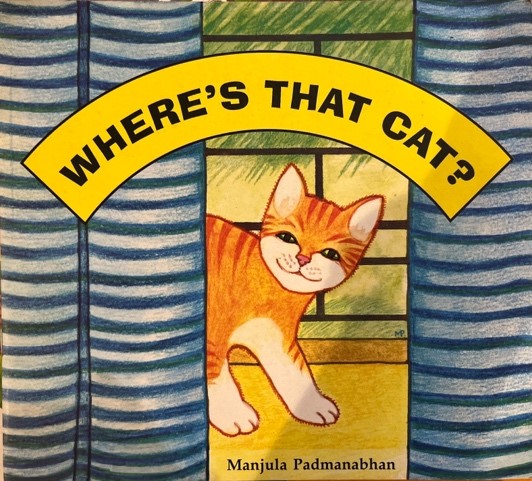
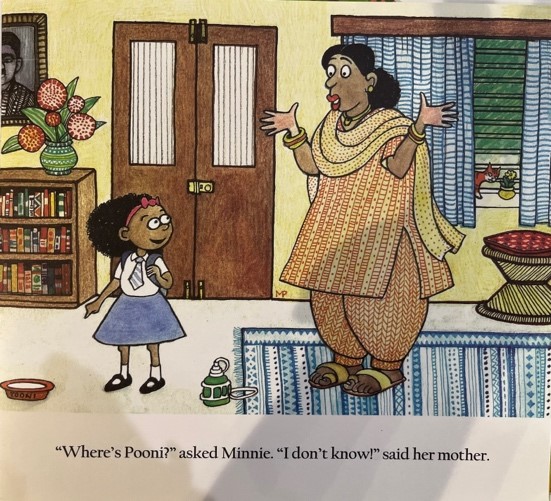
One such picture book is Manjula Padmanabhan’s ‘Where’s that cat?’ (2005). In the book, a little girl is looking for her naughty orange cat on a busy street. Minnie returns from school to discover that Pooni is nowhere to be seen and the milk in the saucer is untouched. As Minnie’s mother shrugs her shoulders, Minnie rushes out to look for Pooni. She walks down the road, stopping to ask all kinds of pedestrians, vendors and passersby if they’ve spotted the cat. The book ends with Minnie happily reunited with Pooni at home.
Design and illustrations
The front cover gives us a hint of the hide-and-seek to follow as we see an endearing Pooni peeping through the curtains, even while Minnie enquires about her. As Minnie steps out, each double page spread shows a landscape view of the bustling street with just a sentence or two beneath each illustration. The full-bleed illustrations, made in bright pastels and dramatically outlined, draw us into Minnie’s anxious search. The humour and suspense are reflected in the text as well as the pictures. While inquiring about Pooni, Minnie never ever uses the word ‘cat’. She always describes a characteristic of Pooni, such as ‘pointy ears’. Only those familiar with the Tamil language would know that the word ‘pooni’ means cat.
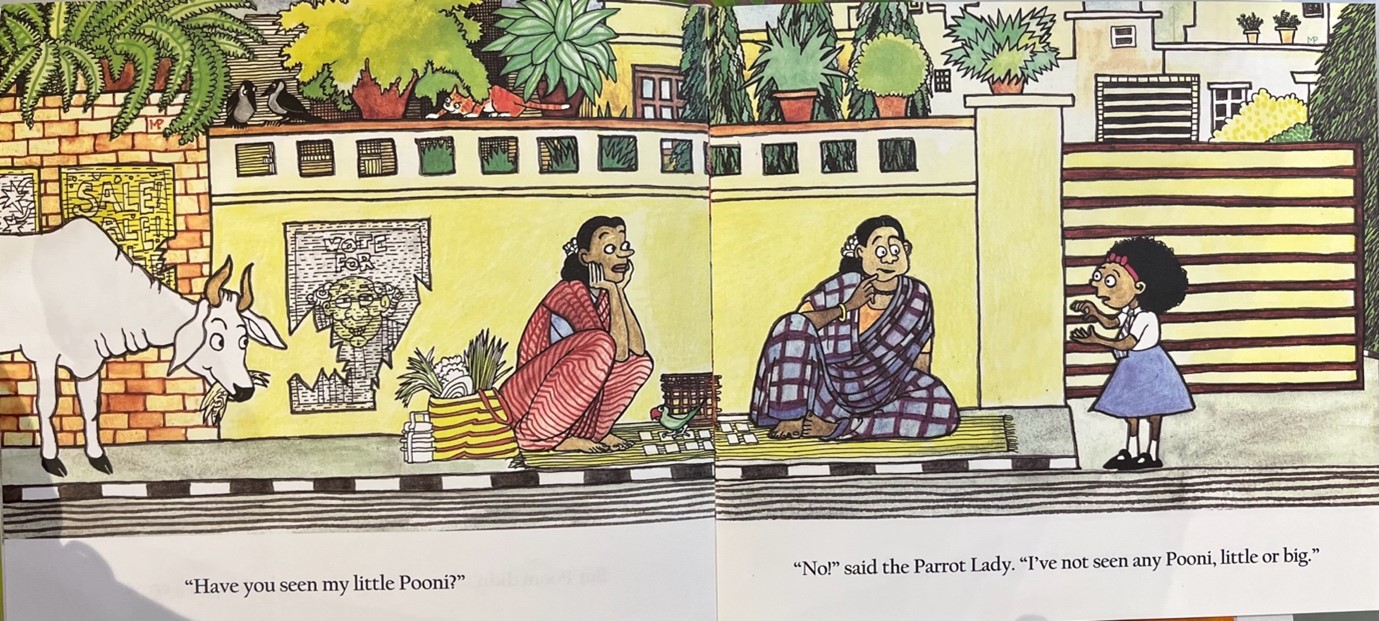
There is humour also in all the side stories depicted on the street. A cow is gleefully chewing on an election poster of a bald politician. When Minnie is retracing her steps to return home, more of the politician is now inside the cow. A poster on a shop advertises a bottled-water brand called ‘Wett’. These sub-plots and side stories playing out on each page, are not just ‘details’, but add tremendously to our enjoyment of the visual experience.
Camera angles
Illustrations in picture books are influenced by ways of seeing from other modes of art, for instance, cinematography. In ‘Where’s that cat?’, our gaze follows Minnie as she moves along the road, at a low angle on her side of the road. It’s like a camera following Minnie on a trolley, like in the movies.
Another remarkable aspect of the pictures is that with each page turn, as Minnie moves down the road, we move along with her. With each page turn, the artist maintains continuity so that some elements of the last frame appear on the next, even when we’ve moved down the road. Imagine if someone were to pull apart the book and paste the pages together, we would have a dramatic landscape view of the teeming street with all its colorful characters and shops!

While on the subject of cinematography, it is worth noting that the one time we see Minnie from across the road is when she suddenly realizes how terrifying the road might be for her cat! Padmanabhan now places us across the road, and we gasp at the dangers on the road–the mad traffic, the loud noise, and the chaos. We feel the horror reflected on Minnie’s face as the illustrator shatters the quaint calm of the street so far. And Padmanabhan achieves this by abruptly zooming out.
Echoes from a whodunit
Picture books are often multi-modal texts borrowing features from other genres and modes of representation. Here, Padmanabhan cheekily uses the ‘double narrative’ feature of a whodunit in which the reader is in on the secret which the protagonist is trying to crack. Even as Minnie anxiously searches for her cat, Pooni is there on each page, playing out her own little chase with a crow. The child-reader feels the thrill of being both deeply involved in Minnie’s inquiries, and at the same time being an observer of all the action. It also adds to the underlying humour as a cat can be deceptive, playing out her own story.
The double narrative adds to what Bader (1976) describes as ‘the drama of the turning of the page’, the unique quality of picture books to build anticipation with each page turn. As we are invited to wonder if Pooni’s shenanigans will be caught, we become more involved in the narrative. We fill in the gaps between pages and become active meaning-makers and storytellers.
Do all these details matter?
For adults who share picture books with children, this is often a vexing question: what if children don’t care for all these details? Well, a deeper engagement with picture books will enable children to go beyond the obvious story of a girl looking for a cat. For that to happen, we as adults might need to hone our visual literacy skills to understand how picture books can be ‘read’, how text and illustrations combine to offer a unique aesthetic experience.
Since we live in an increasingly visual world, appreciating artistic elements of style can enable children to deep dive into comprehending pictures. The ability to deep dive into a picture book, peel back layers, and pay attention to the symbolic nature of visuals, would also be transferred to text-based reading.
References
Bader, Barbara. 1976. American picturebooks from Noah’s ark to the Beast within. New York: Macmillan. P
Padmanabhan, Manjula. 2022. Where’s that cat? Tulika Books.
Sipe, Lawrence R. “The art of the picturebook.” In Handbook of research on children’s and young adult literature, edited by Shelby Wolf et al., 238–52. New York: Routledge, 2011.
Shivani Kumar
September 19, 2025Wow!! ‘Where’s that Cat’ took me back to our college days, when we’d spend hours exploring books, discussing them, and sharing our perspectives. So many wonderful memories came rushing back! I truly enjoyed reading your article, ma’am. We often underestimate wordless or picture books, but the best part about them is how open they are to different perceptions and how they spark creativity.
Zoya
September 19, 2025This article was very interesting! As a storytelling student, I liked how the author explained that pictures in children’s books are not just for decoration but also tell their own story. The example of Where’s that cat? shows how words and pictures work together like a movie. It made me realize that good picture books help children imagine more, feel more, and understand the story in a deeper way.